
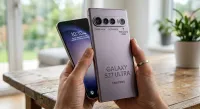
Samsung took the radical decision to remove the floating camera rings altogether. The engineering teams consolidated the optical array into a horizontal module for the flagship Galaxy S27 Ultra, representing an enormous departure from the past four generations of design. The overall chassis thickness remains incredibly slim at 7.9mm, replicating the footprint of the S26 Ultra. However, the overall mass increased substantially with this release, tipping the scales at 218 grams. It becomes immediately apparent that an adjustment must be made while cradling this hunk of metal in one's palm. The additional heft can be directly attributed to the substantial battery innovation taking place underneath the hood. Samsung has finally pushed past the 5,000 mAh threshold for the first time in history, utilizing a 5,700 mAh power cell within the titanium shell. This represents an increase of fourteen percent on the previous generation. Enterprise teams that regularly tether their devices as hotspots or utilize extreme brightness while navigating the construction site will finally have an option that can withstand a 14-hour shift without aggressive thermal throttling or desperately searching for a nearby wall socket.

The display architecture makes full use of the cutting-edge M16 OLED panel, which boasts a staggering 10,000-nit peak brightness, with a comfortable 2,800-nit global maximum. Reading Excel spreadsheets or AutoCAD drawings on the sun-drenched jobsite is no longer an issue. The massive 6.9" panel has incorporated a unique hardware privacy screen built directly into the substrate. Commuting professionals or those who frequently send and receive financial information will no longer have to resort to the low-quality third-party privacy films that substantially degrade the viewing experience. The considerable investment in the M16 panel is protected by Corning's Gorilla Glass Armor 2. Samsung announced that the previous generation dramatically reduced environmental glare. It is difficult to discern an appreciable difference in the appearance between this panel and a panel utilizing the previous Gorilla Glass formulation. The reduced overall glare would be significantly distracting for other smartphone manufacturers, given the extreme whiteness of the Armor 2 glass. This latest glass architecture also results in roughly 30% less power consumption while providing demonstrable improvements to color fidelity. The combination of the increased battery size and the reduced display power consumption will deliver genuinely impressive multi-day battery performance.
The supply chain is highly fragmented at the silicon level. Samsung has been rumored to test the upcoming Exynos 2700 chip on certain regional markets, while the global supply will consist of the Snapdragon 8 Elite Gen 6 Pro for Galaxy. Both chips will utilize a shared 2nm manufacturing process. While the silicon improvements on both chips are genuinely extraordinary, it will create significant headaches for enterprise IT departments. Support for two different processors across multiple markets will severely complicate the deployment of standardized software experiences. Enterprise-level applications will have to be recompiled for both architectures, resulting in appreciable differences in performance and thermal management between devices sold in Europe and devices sold in the United States. The Snapdragon variant makes full use of the newly-introduced LPDDR6 memory standard, which will reduce energy consumption by 20 to 30% while substantially boosting performance in applications that make aggressive use of local AI processing. The internal memory has been upgraded to 12GB of RAM, which will permit sustained execution of the Linux environment via Samsung DeX while also permitting the retention of several large PDF files in the background without experiencing the dreaded application closure prompt.

The imaging subsystem contains some genuinely revolutionary updates at the core. Samsung has officially abandoned the 3x optical telephoto lens, shortening the overall focal length. The optical array now extends from 1x all the way to 5x, with the 5x lens containing a generous 50MP periscope-style 200MP sensor.
The elimination of the 3x optical lens results in substantially more straightforward processing architecture. With only two telephoto lenses to process, the computational photography algorithms can concentrate on delivering natural tones.
The aggressive approach to digital image processing that Samsung had utilized in previous Ultra models has been considerably dialed back. Substantial detail is retained in shadow regions while highlight compression techniques prevent extreme blown-out areas in bright environments.
The front-facing camera has also received a considerable update. The standard 12MP front camera has been replaced with a 16MP module that utilizes physical auto-focus and optical image stabilization. Video conferencing in dimly-lit hotel rooms or capturing essential evidence for the worksite will be significantly more pleasant. Rumors suggest that Samsung may introduce a square configuration that would allow the capture of portrait and landscape-oriented video without physically rotating the device. If this rumor proves to be accurate, it will save tremendous amounts of time for social media managers and corporate communications teams.

The overall weight of 218 grams cannot be ignored. While the 7.9mm thickness would suggest a slim profile when tucked away in a pants pocket, the overall weight distribution renders single-handed operation quite challenging during the morning commute. The addition of a protective sleeve will push the weight above 240 grams, transforming the device into a compact tablet form-factor. The volume rocker switch and power button remain mounted on the right-hand side of the chassis, providing excellent feedback on every press. The ultrasonic fingerprint reader performs exceptionally well, eliminating the occasional false recognition that plagued optical scanners in the rain. The phone remains fully waterproof and dustproof, maintaining the IP68 rating.
The wireless connectivity options have been thoroughly modernized. The logic board is capable of Wi-Fi 7 connectivity, which will enhance file transfers when connected to an enterprise-grade access point. Engineers will be able to transfer large 8K video files or synchronize local databases with much greater speed and reliability. The cellular modem makes full use of the LTE-A standards, which will be essential when operating in concrete server rooms. The phone supports dual SIM and eSIM configurations, which will be vital when attempting to enforce strict separation between personal and professional data. The Bluetooth 6.0 module will maintain a stable connection to multiple devices at once, eliminating the occasional audio dropout during a critical conference call. Finally, the USB Type-C port makes use of the USB 3.2 standard, enabling rapid data transfers between external storage devices and the phone. The entire mobile ecosystem lends itself to rapid and reliable digital operations for enterprise teams.
Samsung's push into the local artificial intelligence space will derive considerable benefit from the 2nm process technology. The Snapdragon 8 Elite Gen 6 for Galaxy has been enhanced with a dedicated neural processing engine, which will keep the most sensitive enterprise data on-premise when utilizing the phone's AI capabilities. The use of local large language models generates considerable heat, which will be rapidly dissipated by the internal cooling system. The thermal management is more than adequate for casual texting or even a few rounds of chess with a friend. However, a prolonged 45-minute video call utilizing a simultaneous language transliteration will begin to exceed the capabilities of this highly-efficient 2nm architecture.

The 200MP ISOCELL HP6 sensor is much larger than the 10MP 3x sensor that it replaced. The ability to capture images of documents from the back of a brightly-lit conference room is vastly improved, as is the ability to crop the image and retain sufficient resolution for contract approval. The shift to the horizontal layout eliminates many of the design challenges presented by the tiny floating rings on the S24 and S26 models. Capturing a building or a machine with the center crop from a 200MP sensor will generate much better results than using an inconveniently-placed 10MP 3x sensor.
The 50MP 5x periscope lens utilizes an optical image stabilization system to maintain exposure consistency at the extreme end of the zoom range. The video subsystem has been greatly enhanced, with the introduction of significantly improved Samsung Log and APV tools. Videographers and cinematographers will be able to capture extremely high-quality video directly to the phone, which can then be transferred to an external storage device for post-processing.
The flat-out ridiculous 200MP resolution is not a prerequisite for 8K video, which remains a niche application. Capturing 4K video at an astonishing 120 frames per second will provide significant flexibility in the post-production process when creating product videos.
The Android 17 operating system has been tailored to maximize productivity on a screen this large. Core elements scale beautifully, permitting side-by-side apps that extend to the very edge of the screen. Dragging and dropping text between an email client and a suspended Slack window is seamless and does not freeze the operating system. The phone makes full use of the Ultra Wideband radio, which permits extremely accurate positioning of equipment or people within a warehouse environment. Alternatively, the phone can make use of this radio to identify secure access points within an enterprise server room, eliminating the need to carry an additional credential.
The audio subsystem has sacrificed the traditional 3.5MM headphone jack in favor of a 32-Bit DAC and aptX-HD audio support. The ability to monitor audio with absolute precision is available with this architecture. While the jack is sorely missed, high-end headphones provide an excellent listening experience.

The cost of this phone is rumored to be significantly higher than the initial release of the S26 Ultra. A painful jump of $1,399 in the United States, representing a steep $100 at retail will need to be justified by the overall improvement in quality and longevity.
The battery, the Armor-grade panel, and the 2nm process will contribute to a significantly longer lifespan. The S Pen remains securely stored within the chassis, providing an excellent option for digital note-taking or schematics. The charging architecture appears to be frustratingly old, as Samsung continues to utilize standard wireless charging speeds. The 5,700 mAh battery will require more than an hour to fully replenish, regardless of the presence of a wall socket.
Most enterprise teams utilizing the Galaxy S24 Ultra or S25 Ultra will struggle to justify the replacement cost. The overall operating environment remains nearly identical between these devices. Enterprise teams that have suffered from the limitations of the battery in the past will find this new offering genuinely revolutionary. The M16 panel with its 10,000-nit peak brightness and integrated privacy filter solves two of the perennial problems faced by enterprise users who operate in the wild. Samsung continues to provide up to seven years of operating system updates, which will be vital as the phone approaches the end of its natural lifespan. It remains to be seen if the thermal improvements offered by the 2nm process and the extraordinary battery capacity outweigh the significant initial investment.






Discussion (Join the conversation)
No comments yet. Be the first to share your thoughts!
Please log in to leave a comment.
Login / Register