
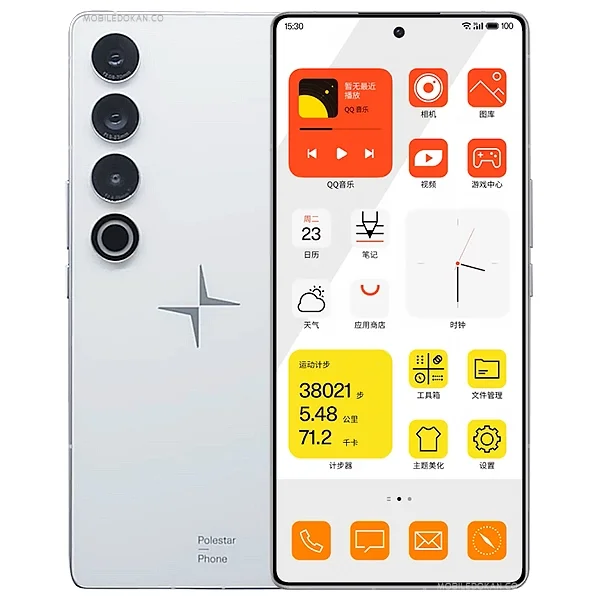
| Network | Technology |
GSM / HSPA / LTE / 5G
|
|---|---|---|
| Launch | Announced | 2024, April 24 |
| Status | Available. Released 2024, April 24 | |
| Body | Dimensions | 165 x 74.4 x 8 mm (6.50 x 2.93 x 0.31 in) |
| Weight | 214 g (7.55 oz) | |
| SIM | Dual SIM (Nano-SIM, dual stand-by) | |
| Display | Size | 6.79 inches, 107.7 cm2 (~87.7% screen-to-body ratio) |
| Resolution | 1368 x 3192 pixels, 21:9 ratio (~511 ppi density) | |
| Protection | Titan Glass 2.0 | |
| Display | 6.79″ 1368×3192 pixels | |
| Platform | OS | Polestar OS |
| Chipset | Qualcomm SM8650-AB Snapdragon 8 Gen 3 (4 nm) | |
| CPU | Octa-core (1x3.3 GHz Cortex-X4 & 3x3.2 GHz Cortex-A720 & 2x3.0 GHz Cortex-A720 & 2x2.3 GHz Cortex-A520) | |
| GPU | Adreno 750 | |
| Memory | Card slot | No |
| Internal | 1 TB | |
| RAM | 16 GB | |
| Main Camera | Triple | 50 MP, f/1.9, 24mm (wide), 1/1.3", 1.2µm, PDAF, OIS10 MP, f/2.1, 72mm (periscope telephoto), PDAF, OIS, 3x optical zoom13 MP, f/2.4, 15mm, 122˚ (ultrawide) |
| Features | HDR | |
| Video | Yes | |
| Selfie camera | Single | 32 MP, f/2.5, (wide), 1/3.14", 0.7µm |
| Sound | Loudspeaker | Yes, with stereo speakers |
| 3.5mm jack | Yes | |
| Comms | WLAN | Wi-Fi 802.11 а/b/g/n/ac/6e/7, dual-band |
| Bluetooth | 5.4, A2DP, LE | |
| Positioning | GPS (L1+L5), GLONASS (G1), BDS (B1I+B1c+B2a), GALILEO (E1+E5a), QZSS (L1+L5), NavIC (L5) | |
| NFC | Yes | |
| Radio | No | |
| USB | USB Type-C, OTG | |
| Features | Sensors | Fingerprint (under display, ultrasonic), accelerometer, gyro, proximity, compass, barometer |
| Battery | Type | Non-removable Li-Po 5050 mAh |
| Charging | 80W wired, PD3 PPS, QC4+50W wireless10W reverse wireless | |
| Misc | Colors | White |
| Expected price | Coming soon | |
| Others | IP68 dust/water resistant (up to 1.5m for 30 min) | |
| Variant | 16GB 1TB | |
| Made by | Sweden |
Mini Review & Verdict
A smart summary of the Polestar Phone
Advantages
- Comprehensive 5G band compatibility for future-proof mobile data speeds
- Elite flagship horsepower and thermal efficiency delivered by Qualcomm SM8650-AB Snapdragon 8 Gen 3 (4 nm)
- High-detail 50MP primary camera sensor backed by Optical Image Stabilization (OIS)
- Dedicated telephoto optical zoom lens for crisp distant portrait and telephoto captures
- High-capacity 5050mAh cell built to reliably sustain heavy daily screen time
Disadvantages
- Employs standard LCD panel technology rather than deep-black AMOLED
- Fixed internal storage configuration without expandable MicroSD card support
Taking a comprehensive view of its technical merits, the Polestar Phone demonstrates a thoughtful balance of hardware capabilities and refined design within Polestar's catalog. Visual duties are assumed by a competent responsive IPS LCD screen measuring 6.79 inches , delivering high-definition clarity, balanced color temperatures, and generous dynamic range for reading and streaming.
Processing throughput is sustained by the well-matched Qualcomm SM8650-AB Snapdragon 8 Gen 3 (4 nm), offering dependable operational stability across varied software demands. Multitasking, web browsing, and multimedia applications execute with dependable rhythm and stable thermal dissipation. Photography needs are addressed with confidence by the primary optical setup—centered on a 50MP primary sensor with optical image stabilization (OIS) and dedicated optical zoom versatility—which maintains pleasing clarity, controlled noise thresholds, and reliable low-light composure.
Longevity is anchored by a 5050mAh battery unit, equipped with 80W rapid charging alongside wireless charging convenience designed to comfortably see users through full days of unhindered mobile operation. In conclusion, the Polestar Phone represents a sensible, thoroughly calibrated package that satisfies demanding real-world criteria across the board.


Be the first to review!